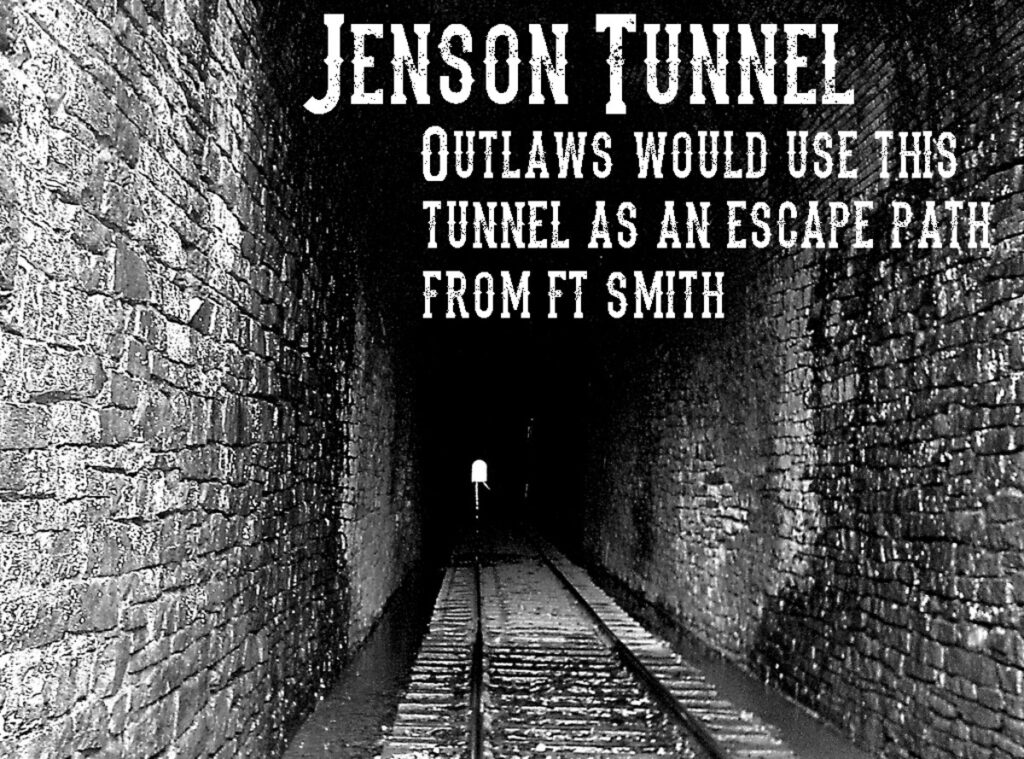
Oklahoma’s Only Railroad Tunnel
The Jenson Tunnel is Oklahoma’s only railroad tunnel. Not only is it Oklahoma’s only railroad tunnel, but it is also the only tunnel in the United States built in a foreign nation.
Constructed in 1885 through 1886 for the Fort Smith & Southern Railway, it is still in use today. Several times a day, rail cars from the Kansas City Southern roll through the tunnel.
The tunnel runs under Backbone Mountain near the site of a large Civil War-era skirmish. It runs at 1,180 feet long and spans 14 feet wide and 20 feet tall.
Military Intervention
At the time that the Jenson Tunnel was constructed, the land was part of an indigenous tribe’s territory. Workers from Ft. Smith were hired to begin work on the tunnel, and soon found opposition.
Many of the Choctaw residents who settled in the area were outraged by the infiltration of the white man into their new homes. They saw the railroad as the start of a large-scale encroachment into their land. A number of them decided to do something about it.
The unrest began early during the construction. Small groups would come to the tunnel site to harass the workers. At first, this wasn’t much and was more of a hindrance than anything. However, a couple of months into construction, under the darkness of night, a large group of resettled Choctaws attacked the railroad workers. This turned into a several-day skirmish, where many of the workers were trapped, defenseless against the onslaught.
A little more than a week into the fighting, the Ft. Smith militia arrived to quell the uprising. For the remainder of construction, members of the militia were stationed there to oversee completion.
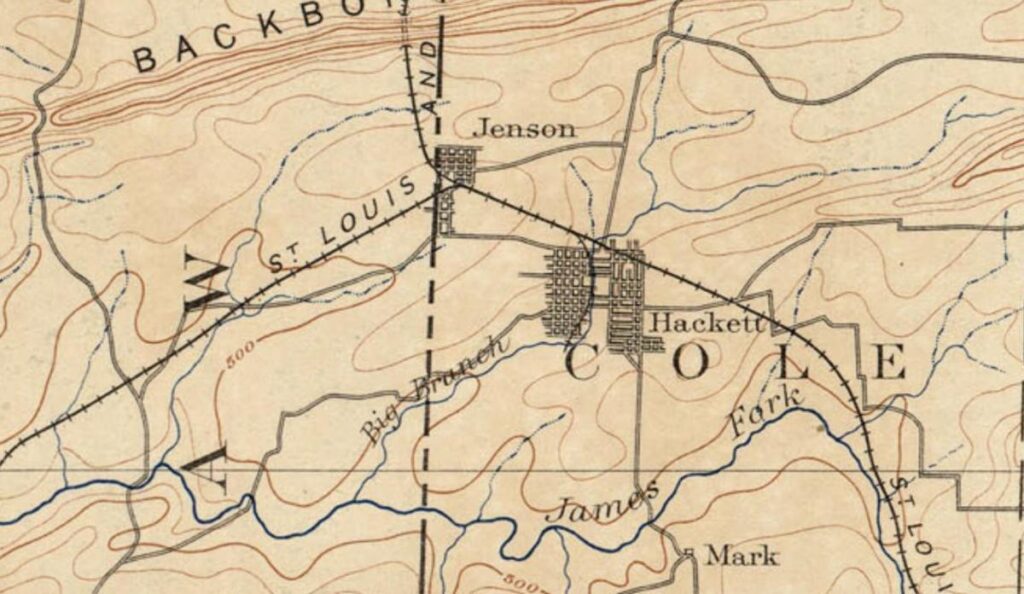
The Tunnel and the Town
Why was the Jenson Tunnel named as it is?
During the late 1800s, a small town located just on the Arkansas side of the border was established. While Ft. Smith was a more law-abiding town, the town of Jenson was a wild and rugged place.
One of the reasons why the town was so lawless was because of alcohol.
While alcohol was outlawed in Indian Territory, it was freely available in Arkansas. After St. Louis and San Francisco arrived, residents would board the train at Poteau Switch, travel through Cameron, and arrive in Jenson, Arkansas. Jenson was once a thriving border town, and many speculate that it was established with the sole purpose of supplying whiskey to people living in the Indian Territory.
The alcohol sold in Jenson was much stronger than what can be found in modern times. Much of the whiskey sold there was made with raw alcohol, burnt sugar, and a little chewing tobacco. It took on names such as Tanglefoot, Forty-Rod, Tarantula Juice, Taos Lightning, Red Eye, and Coffin Varnish.
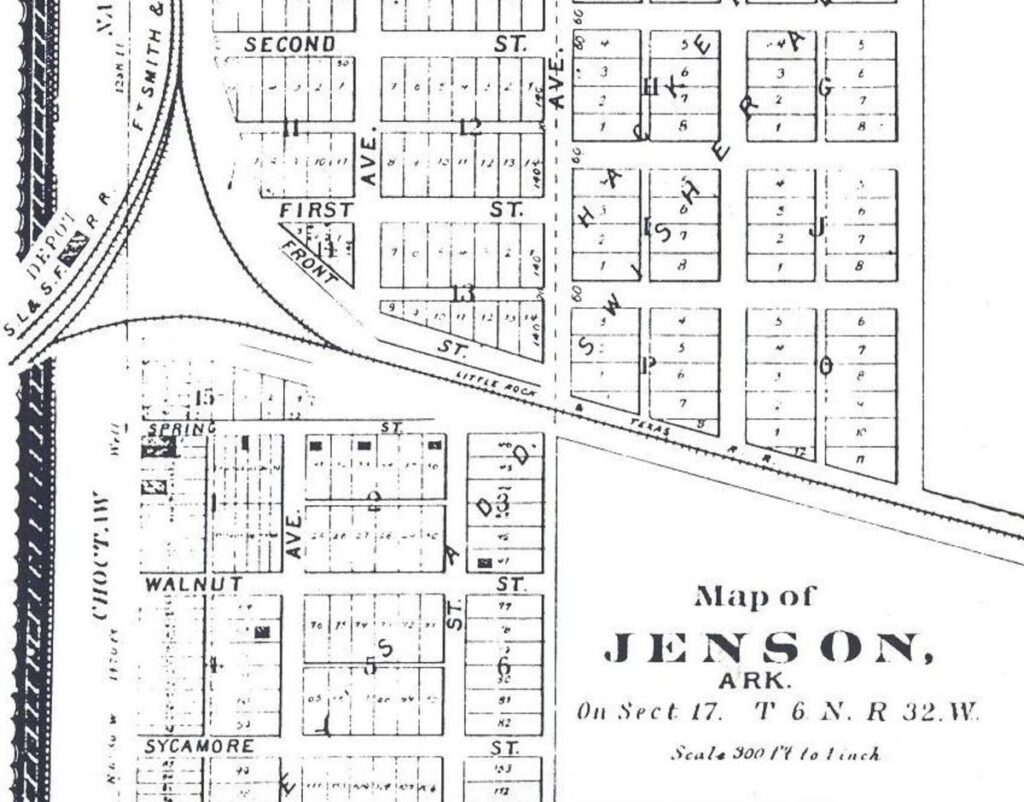
There wasn’t much to the town of Jenson. At its height, it consisted of four buildings; a hotel, a brothel/saloon, and a general store, in addition to the railroad depot. Today, the foundations for both the general store and hotel can still be seen, as well as the rock path that led to the depot.
During the nights, both the hotel and saloon were packed. For those coming from Indian Territory, this was the closest point where they could freely enjoy their whiskey. Gunshots would ring out throughout the night, and there are numerous tales of fights and banditry going on. In fact, the “Hanging Tree” still stands where it did just in front of the hotel.
Jenson’s Wild Days
In July of 1898, two young men threw some eggs into a religious meeting in Jenson in the Choctaw Nation. The preacher swore out warrants for Floyd Simpson and a young man named Self for disturbing religious worship. The warrants were given to Deputy U.S. Marshal L.S. “Bud” Hill and his posseman, J. Boley Grady. The officers located their suspects at the religious meeting in Jenson on July 17 along with Simpson’s father, W. Jasper, a local merchant. Grady was arresting Floyd Simpson who was resisting. Grady had wrestled Simpson to the ground when the boy’s father went up to him and shot him in the neck with a .45 revolver.
As Deputy Hill approached, Jasper Simpson shot him in the chest. The Simpsons then rode away. Deputy Grady died immediately and Hill died within an hour. Grady was survived by his widow and two children as well as his parents and siblings. His father was J.P. Grady who was also a U.S. Marshal. His body was taken to South McAlester for burial. Hill’s body was buried at Kully Chaha, three miles south of Cameron.
Floyd Simpson turned himself in at Hackett City, across the Arkansas line. Jasper Simpson engaged in a letter-writing campaign to the local newspapers declaring his innocence in defending his son. He was eventually arrested and acquitted of the officers’ murders.
The Outlaws of Jenson Tunnel
The Jenson Tunnel was built during the height of the outlaw days in Oklahoma. During this time, Indian Territory was still considered free reign, where only the most determined U.S. Marshals would travel. The Choctaw Lighthosemen had very little control over the white man, so such notorious criminals as Belle Starr, the James Gang, and the Cole-Younger Gang would frequent the area.
The tunnel served as a conduit between Ft. Smith and the lawless Indian Territory. Stories have been told where outlaws would flee the Marshals by racing through the tunnel. In the end, there was a small alcove that was well hidden. Outlaws would use this to hide in, unnoticed, while the Marshals would pass them by. Other stories tell of removable blocks inside the tunnel where robbers would hide their loot, intending to retrieve it at a later date.
The Tunnel and the Town Today
While the myths and legends surrounding the Jenson Tunnel and the Town of Jenson are fascinating, only those granted special access by Kansas City Southern may visit the site. The location where the town of Jenson used to be is now private property, and since the tunnel is still used by the KCS railroad, it is simply too dangerous to allow visitors.
Still, that area has had a lot of activity through the years. By using Google Earth, you may still get an idea of how the area used to look and may catch a glimpse of the former town of Jenson.

© 2017 | Eric Standridge