Somewhere in the wilderness of southeast Oklahoma, there is over a million dollars’ worth of hidden treasure. This is the story of that treasure, the outlaws who robbed it, and the cave system where they hid…
Robbers Cave: The Outlaws’ Hideout
In the years preceding Oklahoma statehood, the Ouachita Mountains remained as wild and rugged as the old west. Heavily forested and lined with hidden caverns and ravines, this area was a favorite hiding place for outlaws and bandits. One such spot, Robbers Cave, is known to have concealed the legendary Jessie James, as well as other famous outlaws including the Youngers, the Dalton Gang, the Rufus Buck Gang, and Belle Starr.
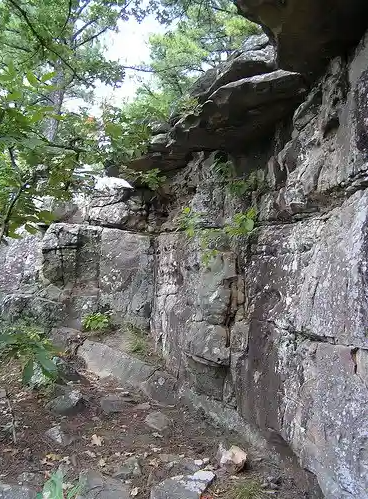
The Robbers Cave area is strewn with rock outcroppings topped with massive boulders and surrounded by dense vegetation. Gentle rivers flow into Lake Carlton just a short distance away. The main cavern runs more than 40 feet back into the mountain, and clear springs once dotted the landscape.
Robbers Cave History and Lore
The lore associated with the Robbers Cave area is vast, dating to its use as an Osage hunting ground and as the subject of French exploration in the 18th century. During the late 1800s, Civil War deserters and outlaws reportedly hid in the cave, including—most famously—the Jesse James Gang.
In choosing this hideout, Jesse didn’t leave things to chance. The area around Robbers Cave offered several strategic advantages that made it the perfect outlaw refuge. The geography and terrain made it an almost impregnable fortress, with the criminals allegedly able to escape through a secret back exit. Additionally, at the base of the cliff, there is a natural stone corral where his gang could easily stow their horses and pack animals. And a natural spring located within the cave provided fresh water.
In 1877, Jesse James and his gang pulled off one of their most audacious robberies. Ultimately, this crime would span three states and incited a massive hunt for the hidden loot.
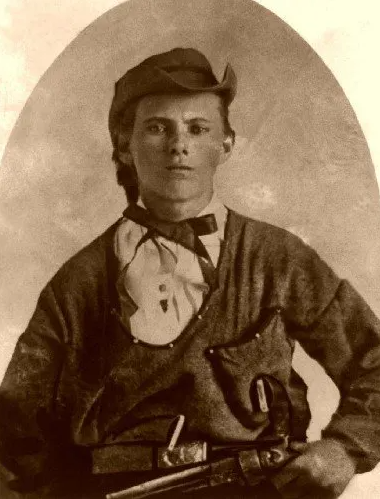
Jesse James’ Hidden Treasure in the Wichita Mountains
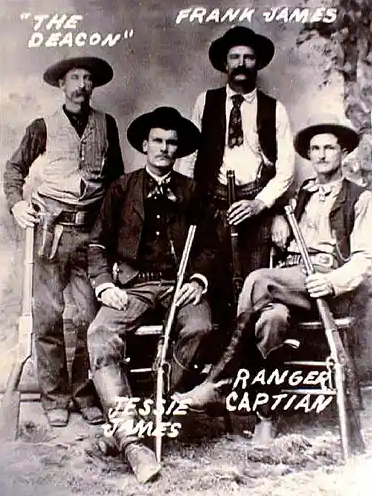
In northern Mexico, near present-day Calera, Jesse and his brother Frank staged a robbery that turned into a modern-day legend. In early 1876, the James brothers and 10 of their brethren attacked a detail of Mexican guardsmen driving 18 burros transporting gold bullion. After securing their loot, the Gang led the pack train across Texas and into Indian Territory, which at this time lacked local and state laws and was notorious for being a favorite hideout for outlaws.
It was sometime in late February when the gang finally reached the Wichitas. A fierce winter blizzard raged across the mountains. For three and a half days, they wearily traveled with little rest through snow almost a foot deep. Jesse soon realized that their exhausted animals could go no further.
In an unknown spot east of Cache Creek, the James Gang buried their stolen treasure in a deep ravine. Jesse made two lasting signs pointing to the gold: He nailed a burro shoe into the bark of one cottonwood tree and emptied both of his six-shooters into the trunk of another.
Jesse James’ Brass Bucket
While the James Gang rode out the storm, Jesse etched out the outlaws’ contract on the side of a brass bucket. The contract bound each member of the outlaw band to secrecy about the gold treasure’s hiding place.
After etching out the contract with an old hammer and tack, Frank and Jesse James buried the bucket and its secret somewhere on Tarbone Mountain. Though the bucket was eventually recovered, the treasure was so well concealed and mythologized that over a century later, treasure hunters and local historians are still puzzled over whether and where it exists.
On the side of the bucket, Jesse etched these words:
“This the 5th day of March, 1876, in the year of our Lord, 1876, we the undersigned do this day organize a bounty bank. We will go to the west side of the Keechi Hills which is about fifty yards from [symbol of crossed sabers]. Follow the trail line coming through the mountains just east of the lone hill where we buried the jack [burro]. His grave is east of a rock. This contract made and entered into this V day of March 1876. This gold shall belong to who signs below.”
Below the pact, the following names were scratched into the bucket: Jesse James, Frank Miller, George Overton, Rub Busse, Charlie Jones, Cole Younger, Will Overton, Uncle George Payne, Frank James, Roy Baxter, Bud Dalton, and Zack Smith.
From there, the gang traveled east towards the Ouachita Mountains before arriving at Robbers Cave. They stayed there for several days. Not wanting to risk returning to the Wichitas, the gang then headed north, intending to return for the stolen loot later in the year.
The End of an Era
Some stories indicate that the gang split up afterward, with some wanting to recover the loot and others wary of the risk.
Six months later, the James Gang was ambushed while attempting to rob the First National Bank of Northfield, Minnesota. While Jesse James escaped, he would never have the opportunity to retrieve his share of the hidden stash. On April 3, 1882, Jesse James was shot to death in Missouri by a member of his own gang. The 2007 film, The Assassination of Jesse James by the Coward Robert Ford, portrayed this legendary finale.
While the cache of gold bullion has never been found, most of the markers pointing to its location have, including the brass bucket bearing the engraved names and a crude map.
Somewhere deep in the Wichita Mountains, a hoard of gold bullion may still remain undiscovered.
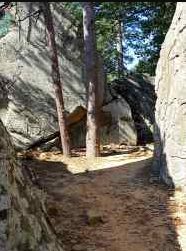
Jesse James in Eastern Oklahoma
This is not the only story of hidden treasure found in the Wichitas. There are hundreds of tales that feature Jesse James and his gang in the area, but only a handful bear any truth. However, it has been documented that the gang did hold up at Robbers Cave several times.
The Oklahoma Gold Rush
During the late 1800s, the Wichitas were in the throes of a massive gold rush, similar to that in California. Over a century earlier, the Spanish had discovered the prospect of gold in the mountains. After the California Gold Rush in the mid-1800s, prospectors moved on in search of new fortunes. By 1890, the Wichita Mountains were teeming with gold seekers. The height of this gold rush came between 1901 and 1904 when over 20,000 prospectors filled the area.
For Jesse James, this wouldn’t do. At first, only a trickle of prospectors came anywhere near his hideout. However, by the 1860s, hordes of miners began moving into the area, overturning every stone and peeking in every crevice in search of gold. Jesse James preferred the relative quiet of eastern Oklahoma.
Other Outlaw Hideouts
Robbers Cave, as it is known today, was one of the gang’s favorite hideouts. However, it was not the only one. Legend tells of a small log cabin hotel located at the base of Sugarloaf Mountain in LeFlore County. Many times during the year, members of the James Gang could be found at this secondary hideaway. Other outlaws, such as Belle Starr and the Younger gang, were known to frequent this place as well.
Further south, a place known as Horsethief Springs remained another popular outlaw rendezvous. Stories from the early days of Poteau and surrounding towns tell of Jesse James strolling through the center of town, which gives further evidence of his association and fondness for eastern Oklahoma.
The Robbers Cave Experiments
Robbers Cave holds another tale of historic proportion. Although not related to the glory days of the American outlaw, this story is still one of treasure and great wealth, but of a different kind.
In 1929, Carlton Weaver donated 120 acres surrounding the cave to the Boy Scouts of America for use as a camp. It was in this camp that psychologist Muzafer Sherif conducted his famous 1954 Robbers Cave experiment on tribalism and conflict resolution.
This series of experiments took boys from intact middle-class families, who were carefully screened to be psychologically normal, and delivered them to a summer camp setting (with researchers doubling as counselors) and created social groups that came into conflict with each other.
The studies had three main phases:
- Group formation, in which the members of groups got to know each other, social norms developed, and leadership and structure emerged.
- Group conflict, in which the now-formed groups came into contact with each other, competing in games and challenges, and competing for control of territory.
- And finally, conflict resolution, where Sherif and colleagues tried various means of reducing the animosity and low-level violence between the groups.
In the Robbers Cave experiments, Sherif showed that superordinate goals (goals so large that it requires more than one group to achieve the goal) reduced conflict significantly more effectively than other strategies (e.g., communication, contact).
These experiments have been the basis of many important discoveries in the science of psychology. The study, which has been described as a real-life Lord of the Flies, was not without controversy, though, as some social psychologists questioned Sherif’s methodology and conclusions.
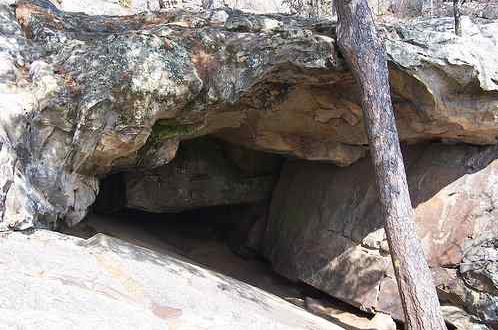
Robbers Cave State Park
Since Carlton Weaver’s land donation in 1929, the Robbers Cave site has undergone many improvements. Soon after the donation, John Newell, warden at McAlester’s State Penitentiary, arranged for a group of skilled inmates to begin renovating the site. Using locally quarried rock, the inmates built a kitchen and several buildings that were used as headquarters for different scout troops. Named Camp Tom Hale in honor of a McAlester businessman and BSA supporter, the facility was adjacent to a tract of land that Weaver had leased and later donated to the state fish and game commission to create a large game preserve.
In 1933, the Civilian Conservation Corps Company 1825 was organized at the state game preserve. Two years later, in 1935, under the supervision of the National Parks Service, the State Parks Division took control of the area. Between 1935 and 1941, the Civilian Conservation Corps Company 1825 built a bathhouse, cabins, trails, group camps, shelters, and roads. Locally quarried stone was used on all of these projects. In 1937, the Civilian Conservation Corps and the Works Progress Administration (WPA) created Lake Carlton, named after the park’s benefactor.
Visiting the Park Today
Standing at the entrance of Robbers Cave, one can almost see the bandits’ crackling fires and hear their laughter as they tell stories of daring and escape. It becomes easy to imagine how these outlaws of old found the place so tempting. During those days, it was rugged wilderness. Only a select few knew of its location. For Jesse James, Belle Starr, the Younger Gang, and many others, it was the perfect place to escape the law and gain a few days of rest.
Today, it is still a perfect place to hide out from the world—a perfect place to escape the fast-paced lives we lead, if even only for a day.
Located four miles north of Wilburton, Oklahoma, on State Highway 2, Robbers Cave State Park encompasses more than eight thousand acres and includes three lakes and many tourist amenities.
© 2010 | Eric Standridge